Make the AI opportunity concrete
Translate the deck into a shared view of trends, examples, and implications for Axis.
 Axis AI Meeting Brief
Axis x Devoteam
A meeting brief for discussing where enterprise AI is moving, what the cases show, and why the next wave matters for Axis.
Focused AI, token economics, and governed agent platforms.
GN, Grundfos, Salesforce Agentforce, Maersk, Engie, and Level.
Where AI-enabled APIs and secure data can shape the portfolio.
Meeting intro
The perspective we want to explore: understand how large end customers - and the surrounding ecosystem - are evolving, and from that decide what offerings and enablers could be valuable to add to the Axis portfolio. Inspiration from comparable Devoteam customer cases helps us see where Axis should focus moving forward.
Translate the deck into a shared view of trends, examples, and implications for Axis.
Discuss which capabilities, services, APIs, data patterns, and operating models could become relevant offers.
Leave with a short list of topics worth exploring further with business owners and technical stakeholders.
Section 1
The strongest pattern across the deck is that enterprise AI is becoming less about tool adoption and more about operating discipline: focus, cost control, secure data access, and repeatable delivery.

Trend 01 - HBR signal
HBR's November-December 2025 article makes the point that many companies stay shallow and broad: lots of experiments, weak ownership, and limited P&L impact.
As AI moves from demo to production, unit economics matter. Every agent, retrieval call, long-context workflow, model choice, and human handover has a cost profile.
The Salesforce Agentforce part of the deck shows why enterprises prefer building agents where security, access rules, and approved data already exist.
As agents become the main consumers of enterprise data, companies are moving it out of siloed systems of record into governed, query-ready layers that AI can reach safely - the GN-style shift toward a lakehouse such as Snowflake.
Value increasingly comes from open platforms that span layers rather than single-vendor lock-in. The Grundfos digital-twin work shows the pattern: intelligent connected components plus simulation, compute, and advisory partners optimizing from component to grid level.
Section 2
The cases show three different kinds of AI value: finding the right opportunities, simulating complex physical systems, and building secure agents on enterprise platforms.

GN Store Nord
For GN (8,700+ employees, 100+ countries), Devoteam's dual-track approach pairs top-down executive interviews with a bottom-up AI X-Ray that scans the organization for opportunities, then sequences them into a focused, high-value backlog and an agentic operating model.

Grundfos
The Grundfos examples show AI moving into engineering and infrastructure planning: component-level simulation, plant-level digital twins, and grid-level scenario modeling.
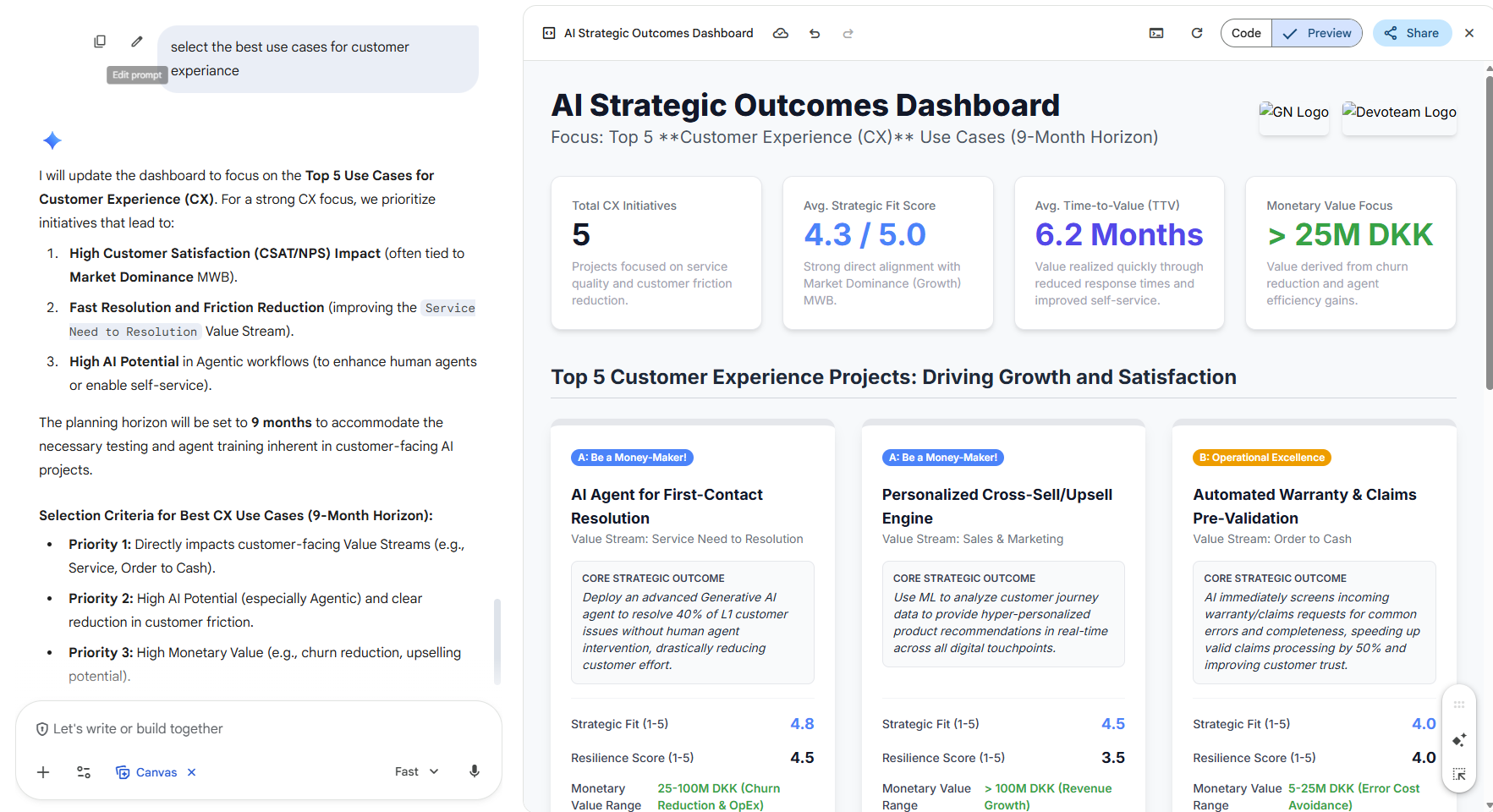
Salesforce Agentforce
The Agentforce story is about speed and trust. Agents can inherit existing CRM security, use approved data, and hand over to humans when risk or frustration rises.

Maersk and broader proof points
Maersk's autonomous coding and Trade & Tariff Studio examples point to a bigger shift: companies can turn specialist knowledge and internal platforms into software-enabled services.
Section 3
Axis can use this discussion to decide where AI becomes part of the customer value proposition, the partner ecosystem, and the technical portfolio.
Which customer journeys, partner workflows, service processes, or product experiences have the clearest measurable value?
How should CRM, product, support, device, and operational data be exposed safely to AI-enabled services?
Which APIs, agent patterns, governance controls, integrations, or customer-facing modules could become repeatable portfolio enablers?
What AI FinOps model is needed to track token cost, latency, quality, risk, and business impact at scale?